

Key points
- This Gems and Jewellery News report highlights that Richemont’s jewellery maisons accounted for more than 70 percent of the total revenue, registering an 11 percent increase in sales at constant exchange rates—a third consecutive quarter of double-digit growth for the category.
- Despite a challenging economic environment and declining consumer confidence in several markets, Richemont’s jewellery division once again emerged as the star performer, delivering double-digit growth and helping the group outpace rivals in the high-end retail space.
- The Middle East and Africa were not far behind, also logging a 17 percent surge in sales, driven in part by the spending power of luxury consumers in the United Arab Emirates.
Gems and Jewellery News: Jewellery Outshines All Other Segments at Richemont
Swiss luxury powerhouse Richemont has defied the broader slowdown in the global luxury sector, reporting an impressive 6 percent year-on-year rise in quarterly sales—driven largely by surging demand for its high-end jewellery brands such as Cartier, Van Cleef & Arpels, Buccellati, and Vhernier. Despite a challenging economic environment and declining consumer confidence in several markets, Richemont’s jewellery division once again emerged as the star performer, delivering double-digit growth and helping the group outpace rivals in the high-end retail space.
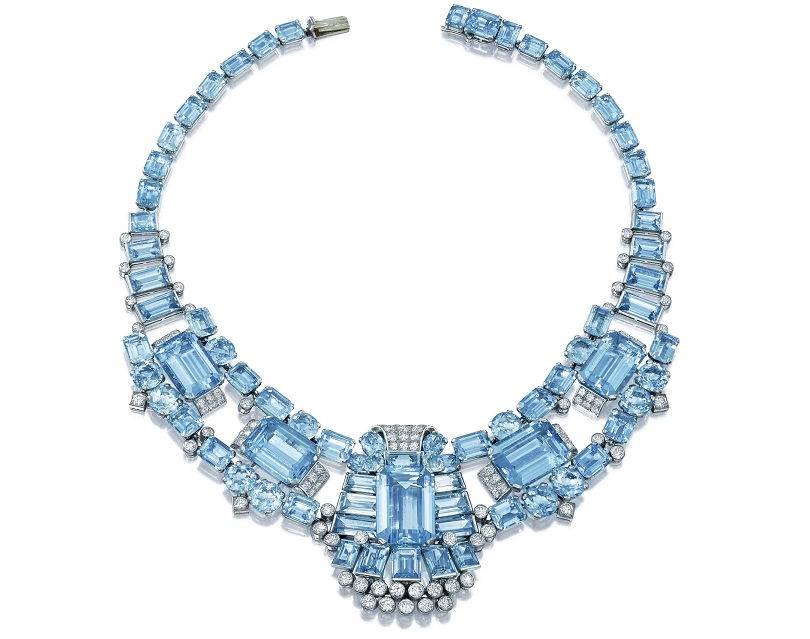
A much sought-after magnificent Cartier London necklace featuring 169.85 carats of aquamarines and 9.64 carats of diamonds, radiating timeless elegance and priced at US$1.1 million
Image Credit: Cartier
According to Richemont’s latest financial disclosure, the first fiscal quarter ending June 30 saw group revenues climb to €5.41 billion (US$6.28 billion), a 3 percent gain at actual exchange rates and 6 percent at constant rates. This Gems and Jewellery News report highlights that Richemont’s jewellery maisons accounted for more than 70 percent of the total revenue, registering an 11 percent increase in sales at constant exchange rates—a third consecutive quarter of double-digit growth for the category.
America and the Middle East Lead Jewellery Surge
By region, Richemont saw its strongest growth in the Americas, where sales jumped 17 percent at constant exchange rates, beating forecasts and confirming robust local demand across all distribution channels. Europe followed closely with an 11 percent increase, fueled by strong performances in Italy and Germany. The Middle East and Africa were not far behind, also logging a 17 percent surge in sales, driven in part by the spending power of luxury consumers in the United Arab Emirates.
Asia-Pacific sales remained flat overall, weighed down by a 7 percent dip in China, Hong Kong, and Macau. However, this was partially offset by double-digit growth in other parts of the region, including Australia and South Korea. In Japan, a sharp 15 percent drop in sales was attributed to the strengthening yen and waning tourist spend, especially among Chinese visitors.
Cartier and Van Cleef Stay Resilient Amid Uncertainty
Richemont’s success is largely anchored in the enduring popularity and perceived value of its jewellery offerings. Flagship brands Cartier and Van Cleef & Arpels continued to resonate with affluent consumers, who are increasingly drawn to timeless, investment-grade pieces over more ephemeral luxury items like handbags and fashion accessories.
Richemont chairman Johann Rupert credited the group’s resilient performance to its disciplined approach to pricing. During the pandemic and the subsequent boom period, Richemont resisted the urge to raise prices aggressively, a strategy that Rupert believes has preserved trust and loyalty among its clientele. “We have to be sensitive to the loyal local clients, and we will not make sudden, rapid increases,” he said.
Cartier did introduce modest price hikes in May to offset rising input costs—including the soaring price of gold and fluctuations in foreign exchange—but these increases were conservative. Morgan Stanley analysts noted the adjustments were lower than expected, ranging from zero in the UK to around 5 percent in South Korea.
Luxury Watches Still Struggling but Showing Signs of Life
While Richemont’s jewellery segment sparkled, its specialist watch division—which includes prestigious names such as Jaeger-LeCoultre, Vacheron Constantin, IWC Schaffhausen, and Panerai—continued to struggle. Sales in this category dropped 7 percent year-on-year at constant exchange rates and 10 percent at actual rates. The decline, although still concerning, represented a slight improvement from the previous quarter.
The watch segment’s underperformance was largely driven by ongoing weakness in China and Japan, though double-digit growth in the Americas helped soften the blow. The Swiss watch industry as a whole remains under pressure, facing declining exports and uncertainty surrounding U.S. tariffs. Industry analysts predict that 2024 could mark the weakest year for watch exports since the height of the pandemic in 2020.
Fashion and Accessories Falter While Watchfinder Shines
Richemont’s “Other” division—which includes its fashion and accessories brands such as Chloé, Alaïa, and Dunhill, as well as the pre-owned watch platform Watchfinder & Co.—posted mixed results. Overall, sales dipped 1 percent at actual exchange rates and 4 percent at constant exchange. However, Watchfinder stood out with robust growth, benefiting from a growing global interest in the secondary luxury watch market.
Despite the underwhelming performance of some of its fashion brands, Richemont analysts remained optimistic. Citi’s Thomas Chauvet praised the group’s momentum, while Deutsche Bank analysts noted that Richemont’s jewellery division “will likely keep it as the standout luxury performance for this quarter.”
Richemont’s Steady Strategy and Loyal Client Base Pay Off
Richemont’s cautious approach to pricing and its focus on high-value offerings have helped it navigate the volatility currently plaguing the luxury sector. With other giants like LVMH reporting weaker-than-expected results, Richemont’s steady growth in jewellery underscores the power of timeless craftsmanship and consumer trust in uncertain times.
Sales of luxury goods globally declined by 1 percent last year and are projected to fall by another 2 to 5 percent this year, according to Bain & Co. Yet Richemont’s shares have climbed 9 percent year-to-date, while LVMH stock has fallen more than 25 percent, highlighting the Swiss group’s relative strength.
As geopolitical tensions, inflationary pressures, and market volatility continue to affect consumer sentiment, Richemont’s stronghold in fine jewellery may prove to be its best hedge against ongoing turbulence. The group’s commitment to preserving the long-term value of its brands rather than chasing short-term gains seems to be resonating with consumers who are now more selective and investment-driven in their luxury purchases.
With its jewellery maisons continuing to outperform, Richemont has positioned itself as a shining example of how legacy craftsmanship, smart pricing, and brand integrity can sustain growth even in a slowing market. And while the challenges in the watch and fashion divisions remain, the group’s jewellery dominance offers a stable path forward in 2025 and beyond.
For the latest Gems and Jewellery News, keep on logging to Bangkok Gems News.