

Key points
- One of the defining moments for the gemstone came at the Golden Globes, when actress Zendaya stunned in a Bulgari high jewellery necklace anchored by a 31-carat oval Paraiba tourmaline.
- Originally discovered in Brazil’s Paraíba state, the gemstone stunned the gemological community with its electric, lagoon-like glow—thanks to traces of copper and manganese that give it a nearly phosphorescent quality.
- That versatility has been fully explored by brands like Pomellato, with its Barocco necklace that sets a free-form Paraiba in a splash of multicoloured stones.
Gems and Jewellery News: The Rare Gemstone That’s Dazzling the World
In the glittering world of luxury gems, a once-obscure stone has ignited a fever among jewellers and collectors worldwide. The Paraiba tourmaline, with its hypnotic neon-blue hues, has risen meteorically in status to rival the most precious of stones—diamonds, rubies, and emeralds. Just last September, a 5.44-carat cushion-shaped Paraiba tourmaline ring sold at Bonhams New York for a jaw-dropping US$533,900, far surpassing its estimated US$60,000 price range.
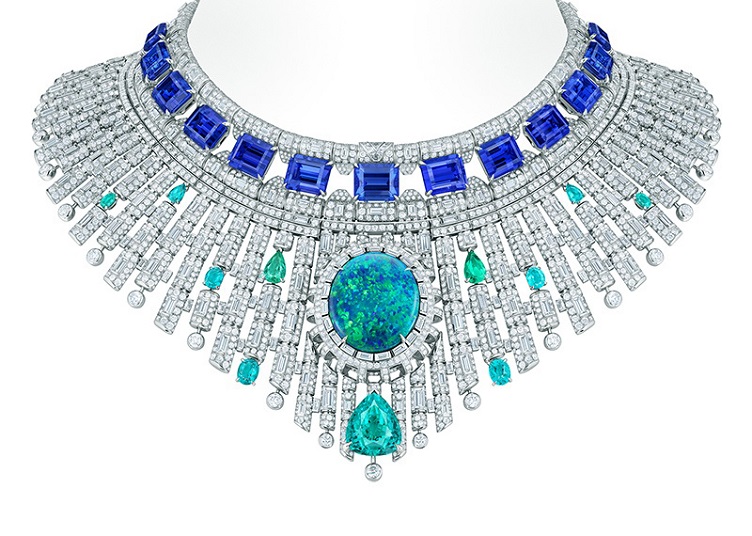
Louis Vuitton’s Bones necklace from the Deep Time collection features a 20.93-carat pear-cut Mozambique Paraíba tourmaline
Image Credit: Louis Vuitton
This Gems and Jewellery News report explores how this rare tourmaline—first unearthed in Brazil in the late 1980s—is now reshaping high jewellery collections from elite brands like Dior, Bulgari, and Van Cleef & Arpels. In an industry where historical prestige typically reigns, this upstart gem is turning heads, opening wallets, and commanding centre-stage.
From Forgotten Earth to Fashion’s Forefront
Unlike many stones whose legacies span centuries, Paraiba tourmalines have only graced human adornment for a few decades. Originally discovered in Brazil’s Paraíba state, the gemstone stunned the gemological community with its electric, lagoon-like glow—thanks to traces of copper and manganese that give it a nearly phosphorescent quality. The Brazilian mines, however, were shallow and yielded small quantities. By the late 1990s, production had significantly dwindled, driving prices up to US$50,000 per carat.
Fortunately for gem lovers, deposits were soon discovered in Mozambique and Nigeria. While these African tourmalines boast larger sizes and fewer inclusions, purists still place Brazilian stones on a pedestal due to their intensity of colour. “Brazilian Paraibas often have more inclusions but display a more electric blue hue,” explained Jeremy Morris, CEO of London’s David Morris jewellers. “African stones tend to be cleaner but carry a slightly softer, washed-out tone.”
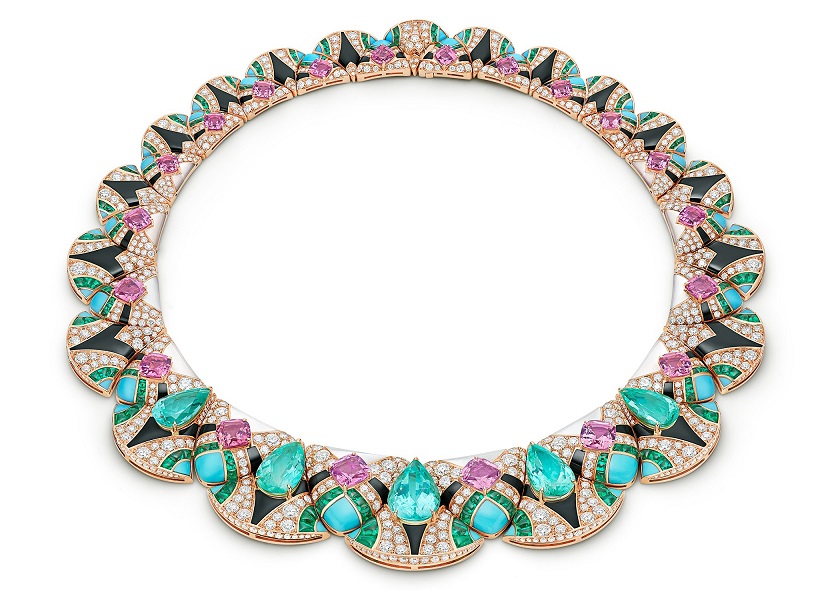
Bulgari Mosaic of Time necklace from the Aeterna collection with Paraiba and pink tourmalines.
Image Credit: Bulgari
Hollywood and Haute Couture Approve
One of the defining moments for the gemstone came at the Golden Globes, when actress Zendaya stunned in a Bulgari high jewellery necklace anchored by a 31-carat oval Paraiba tourmaline. The piece, layered with over 48 carats of diamonds, made headlines not just for its craftsmanship but for elevating the gemstone to global celebrity status.
Design houses are now eager to incorporate Paraibas in their most dazzling collections. Dior’s Diorama & Diorigami line features egg-like Paraiba gems nestled between whimsical diamond birds. Bulgari’s Aeterna mosaic necklace layers pear-shaped Paraibas with emeralds, turquoise, and onyx. Swiss jeweller Boghossian, inspired by Silk Road palaces, released a statement suite with large pear-shaped and cabochon Paraibas sourced from both Brazil and Mozambique.
A Painter’s Palette of Possibilities
Designers adore Paraiba tourmalines not only for their allure but for their versatility. “New materials create new excitement,” said jewellery expert Katerina Perez, who co-authored Paraiba: The Legacy of a Color with gemologist Kevin Ferreira. “Paraiba allows jewellers to play on contrasts, mix materials unconventionally, and showcase beauty in faceted, carved, or even rough forms.”
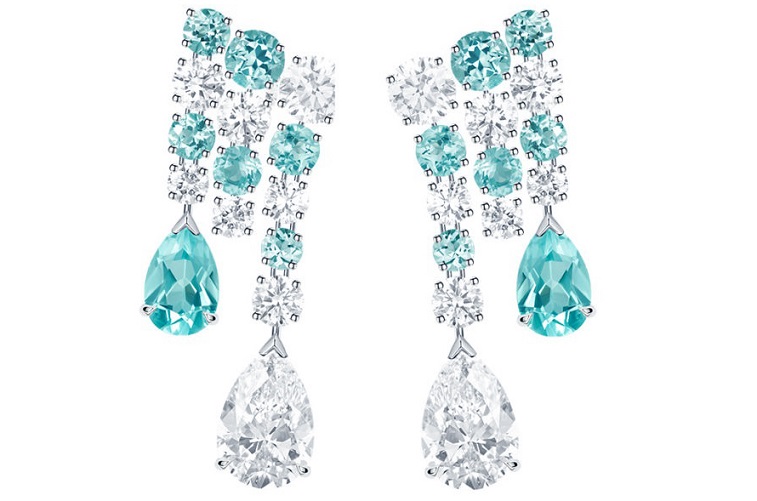
Piaget Aqualusion earrings in white gold with Mozambique Paraíba tourmalines and diamonds.
Image Credit: Piaget
That versatility has been fully explored by brands like Pomellato, with its Barocco necklace that sets a free-form Paraiba in a splash of multicoloured stones. Singapore’s Simone Jewels uses them in swirling diamond rings, while Hong Kong’s Forms combines them with metals like shakudo and aluminium. Cartier has even experimented with green Paraiba varieties in its high jewellery and watch designs, introducing a broader colour spectrum beyond the classic blue-green.
The Collectors’ Craze
Rarity drives demand, and that’s certainly true here. According to Perez, the original Brazilian mines are virtually depleted, meaning those stones now circulate primarily in vintage jewellery or secondary markets. Ferreira highlighted that during the pandemic, investors turned to Paraibas as alternative assets—some seeing 30 to 50 percent returns. “Those who bought during COVID now sit on a goldmine,” he said.
Paraiba prices are highly dependent on colour, origin, and clarity. Brazilian stones remain the most valuable, but Mozambican Paraibas—larger, often cleaner, and vividly coloured—are more accessible to collectors and contemporary designers. Despite their differences, all copper-bearing tourmalines—regardless of geography—can be called Paraibas, a designation now recognised by international gemological labs.
A Sensation That Shows No Signs of Slowing Down
Whether showcased in a headline-grabbing high jewellery piece or delicately paired with unconventional metals, Paraiba tourmalines continue to enchant audiences across continents. The gem’s growth from a geological curiosity to a fashion centrepiece in just over three decades is nothing short of astonishing. It offers a potent mix of rarity, beauty, and investment potential that few other stones can match.
What sets the Paraiba apart is not just its neon glow or limited supply—but its emotional appeal. “Paraiba is a statement,” said Perez. “It turns heads. You wear it when you’re ready to be noticed.”
As the jewellery world grows bolder, more experimental, and colour-forward, the Paraiba tourmaline may very well become the defining stone of a new era. Whether in a cocktail ring, a red-carpet necklace, or a collector’s safe, its luminous blue will continue to shimmer with the story of a gemstone that wasn’t just discovered—but destined to dazzle.
For the latest Gems and Jewellery News, keep on logging to Bangkok Gems News.