

Key points
- Thailand’s long-standing love affair with gold has entered a new and far more powerful phase, one that is no longer confined to tradition, jewelry, or spiritual symbolism.
- One of the most visible side effects of Thailand’s gold boom has been the strengthening of the Thai baht.
- On volatile trading days, gold-related flows can represent over 20 percent of total forex volume, a dramatic jump from less than 9 percent a decade ago.
Bangkok Gems News: A Cultural Obsession Turns into a Financial Force
Thailand’s long-standing love affair with gold has entered a new and far more powerful phase, one that is no longer confined to tradition, jewelry, or spiritual symbolism. Gold has become a dominant financial force, shaping currency movements, trade flows, and even regulatory priorities. What was once a cultural constant is now a macroeconomic variable with far-reaching consequences.
For generations, gold has represented stability, prosperity, and personal security in Thai society. It decorates temples, marks milestones, and serves as a trusted store of value for families across income levels. Unlike in many Western markets, Thai consumers often buy gold regardless of short-term price swings, driven by cultural belief rather than pure speculation. However, this Bangkok Gems News report observes that the traditional mindset has merged with modern trading behavior, creating an unprecedented surge in both physical and digital gold transactions.
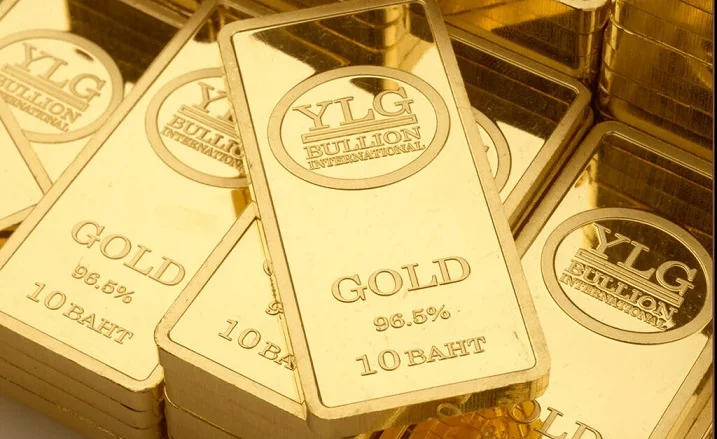
Image Credit: Bangkok Gems News
Explosive Growth in Gold Trading
Thailand’s gold market has expanded at a remarkable pace over the past two years. The country ranked seventh globally for over-the-counter gold purchases, acquiring 39.8 tonnes, a 17 percent increase year on year. More than 90 percent of gold bar transactions are now linked to investment or speculative activity rather than jewelry consumption. Bangkok’s Yaowarat district remains the physical heart of the trade, with gold shops handling massive daily volumes, while mobile trading apps have opened the market to first-time retail investors nationwide.
This surge has pushed gold to account for as much as 35 percent of Thailand’s foreign exchange transactions. On volatile trading days, gold-related flows can represent over 20 percent of total forex volume, a dramatic jump from less than 9 percent a decade ago. Such volumes are no longer peripheral; they are large enough to move markets.
The Baht Strengthens, Pressure Builds
One of the most visible side effects of Thailand’s gold boom has been the strengthening of the Thai baht. As exporters sell gold overseas and convert US dollar proceeds back into local currency, demand for the baht rises. Combined with a weaker US dollar and Thailand’s sizable current account surplus, this has pushed the baht to multi-year highs.
By early 2026, the currency had appreciated roughly 8 percent year on year, trading below 31 baht to the US dollar. While a strong currency often signals economic confidence, Thailand’s export-driven economy tells a more complicated story. Economists estimate that every one-baht appreciation against the dollar can shave up to 0.2 percentage points off GDP growth. With 2026 growth projections hovering around 2 percent, currency strength has become a serious headwind.
Exports and Tourism Feel the Strain
Exporters have been among the most vocal critics of the strong baht. Although gold exports themselves surged by more than 400 percent year on year in mid-2024, boosting headline export figures, non-gold exports tell a weaker story. A stronger baht makes Thai goods more expensive abroad, eroding competitiveness in key markets. Many exporters argue that an exchange rate closer to 33 baht per dollar would provide much-needed relief.
Tourism, which contributes roughly one-fifth of Thailand’s GDP, is also feeling the impact. As the baht strengthens, Thailand becomes a more expensive destination for international visitors. This affects not only arrival numbers but also spending patterns, complicating the sector’s post-pandemic recovery and putting pressure on small businesses dependent on foreign tourists.
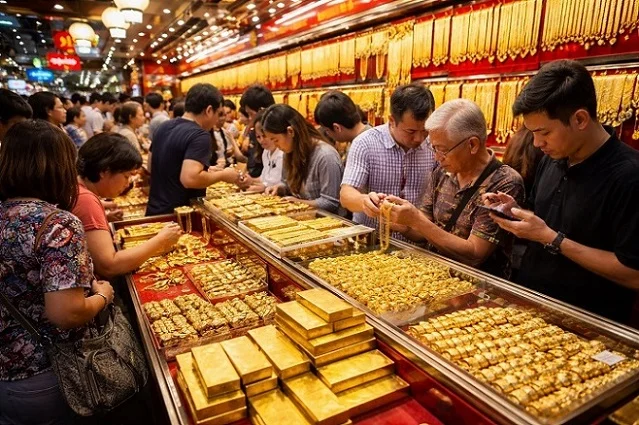
Image Credit: Bangkok Gems News
Capital Locked in and Consumers at Risk
Beyond macroeconomic effects, the gold frenzy has tied up vast amounts of household capital. Speculative trading has led some retail investors to suffer losses during price corrections, reducing disposable income at a time when inflation remains a concern. Money parked in gold is money not spent in the broader economy, dampening consumption and slowing recovery momentum.
Gold-driven currency volatility has also caused the baht to deviate from regional peers, making it harder for businesses to plan and hedge effectively.
Rising Alarms Over Grey Money
Perhaps the most sensitive issue surrounding Thailand’s gold boom is the growing concern over illicit financial flows. Authorities have raised alarms about grey money linked to transnational crime, including online scams, drug trafficking, and money laundering. Bangkok’s role as a regional banking hub has made it a conduit for funds from across the Mekong region.
Estimates suggest that as much as one trillion baht may be laundered annually through gold-related channels. Funds from scam operations in neighboring countries are believed to be partially funneled into gold, exploiting opacity in trading systems. High-profile fraud cases, including a 2024 scam affecting more than 1,000 victims, have highlighted systemic vulnerabilities.
Regulators Move to Tighten the Net
In response, the Bank of Thailand and other regulators have begun rolling out tighter controls. New rules introduced in January 2026 cap online baht-denominated gold transactions at 50 million baht per user per day, effective March. Authorities are also considering business taxes on online gold trading, stricter reporting thresholds, and mandatory disclosures for large-scale traders.
Plans are underway for a centralized data bureau to track transactions across gold, digital assets, and e-wallets, with record-keeping requirements of up to three years. While these measures focus on transparency rather than direct currency intervention, they signal a shift toward closer oversight of a market once driven largely by tradition.
Where Culture Meets Economic Reality
Thailand now faces a delicate balancing act. Gold remains deeply woven into the nation’s cultural fabric, yet its modern financial role is reshaping currency dynamics, trade competitiveness, and regulatory priorities. Managing this transition without undermining confidence or cultural norms will be a defining challenge. How effectively authorities curb risks while preserving stability will determine whether gold continues to shine as a national asset or becomes a growing economic burden.
For the latest on the gold markets in Thailand, keep on logging to Bangkok Gems News.