

Key points
- Ethnic Thais in Thailand’s Gems and Jewelry Trade basically want the next government to return the industry to Thais and to have all the Indians in the trade eradicated from the market.
- Their case rests on a belief that Thailand once regarded across the world as the natural hub of rubies, sapphire and coloured-stone craftsmanship has slowly ceded influence to foreign brokers basically Indians, who they say now dominate crucial layers of the market.
- A growing bloc of Thai gemstone cutters, designers, manufacturers, traders and even retailers are demanding that the next government move decisively to strengthen domestic control of the country’s celebrated gem and jewellery sector.
Bangkok Gems News: Rising calls for policy reset
A growing bloc of Thai gemstone cutters, designers, manufacturers, traders and even retailers are demanding that the next government move decisively to strengthen domestic control of the country’s celebrated gem and jewellery sector. Their case rests on a belief that Thailand once regarded across the world as the natural hub of rubies, sapphire and coloured-stone craftsmanship has slowly ceded influence to foreign brokers basically Indians, who they say now dominate crucial layers of the market.
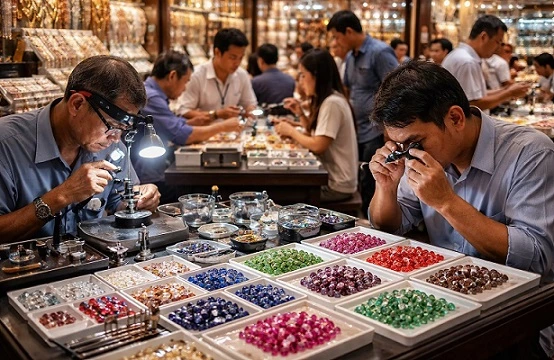
Ethnic Thais in Thailand’s Gems and Jewelry Trade basically want the next government to return the industry to Thais and to have all the Indians in the trade eradicated from the market
Image Credit: StockShots
These jewellers argue that earlier eras of policymaking especially under business-friendly administrations lead by the Thaksin regime loosened controls so extensively that Indian middlemen secured vital channels from sourcing to exports. This Bangkok Gems News report finds that frustration has reached a boiling point among small and mid-sized Thai operators who feel squeezed out of the very industry their parents and grandparents helped pioneer. They describe a system in which local talent is eclipsed by networks of Indian brokers whose priorities they claim are not aligned with Thailand’s long term economic interests.
Allegations and market pressure
Speaking on background, workshop owners in Chanthaburi Bangkok and Kanchanaburi recount a pattern of what they see as structural disadvantage. They point to unverified accounts circulating in trade circles alleging that some foreign brokers have skirted rules on import duties and have blurred the line between natural stones and more affordable laboratory produced materials. Several sellers say price distortions have widened with natural stones pushed aside by composites and synthetics that are not always disclosed accurately when passing along the supply chain.
A common theme is that the margin pressure on Thai artisans has intensified. Local cutters who once commanded a global reputation for precision, hand-finishing say they now compete against bulk parcels that enter the market cheaply and rapidly. Retailers complain that tourists and overseas buyers no longer instinctively associate Thailand with authenticity and craftsmanship but instead encounter muddled messaging about origin and quality.
Concerns over compliance and reputation
Stakeholders fear that even isolated wrongdoing if left unanswered could damage Thailands broader brand. Customs specialists and former trade consultants say that while the nation maintains sophisticated inspection systems, perceived loopholes can erode confidence if exploited repeatedly. They warn that allegations of mislabelling synthetic stones and channel stuffing undermine a decades long effort to differentiate Thai jewellery as transparent trustworthy and high value.
The stakes are heightened by shifting global expectations. US and European importers demand traceability and environmental due diligence. Online consumers expect clarity on provenance. Thai exporters observe that failing to adapt or enforce standards with consistency risks losing the country’s hard won advantage to emerging competitors in Vietnam, China and Africa.
Economic imbalance and lost opportunity
Many Thai operators also focus on what they describe as an uneven trade relationship with India.. one of the world’s most prolific polishing centres. Import totals show Thailand purchasing large volumes of cut stones and jewellery from Indian factories while outbound shipments of finished Thai made pieces to India remain comparatively limited. Local jewellers argue such imbalances leave little space for Thailand to climb the value chain.
Industry voices note that foreign owned networks reportedly control wholesale channels in Bangkok’s major gemstone districts, capturing profits while local workshop staff receive wages that have not kept up with the cost of living. They say the pool of homegrown craftspeople has shrunk as apprentices drift to other work and as young designers struggle to find affordable stones to train on.
What local players want next
Thai jewellers outline several policy wishes. They call for transparent licensing rules that reward firms demonstrably based in Thailand employing Thais and investing in technology. They want targeted grants so small and medium producers can procure rough stones directly from African and South American mine sources instead of relying on intermediary Indian traders. And they urge funding for AI assisted cutting polishing and certification tools to reinforce Thailands credibility as a precision finishing hub instead of depending on Indian imports.
Some propose fresh enforcement and disclosure standards including digital traceability registers for every stone moving through the country. Others lobby for export promotion programmes that would help Thai designers and ethnic Thai manufacturer to build name recognition in the United States the Middle East and East Asia where demand for coloured gems is expanding fast.
Looking ahead
As debate intensifies analysts emphasize balance. Thailand built its gem identity on openness global trade and technical mastery not on isolation they caution. But they add that the current moment offers a chance to recalibrate rules in favour of quality verified provenance responsible sourcing and equitable local employment. If policymakers heed calls for smart investment and stronger oversight the nation could reclaim its position not by shutting doors but by redefining standards of trust transparency and innovation.
Many in the sector believe that a renewed national focus combined with skilled oversight and targeted funding could revitalize a field deeply intertwined with Thai culture. They imagine a marketplace where Thai workshops once again produce the pieces that command global attention where designers thrive on fair access to materials and where visitors view Bangkok not merely as a transhipment waypoint but as the rightful capital of coloured gemstone artistry. Whether the next government seizes that opportunity will shape the livelihoods of thousands of families who have long considered gemstones not simply merchandise but heritage craft and identity woven into modern economic growth and pride.
For the latest on the local Thai Gems and Jewelry industry, keep on logging to Bangkok Gems News.