

Key points
- Natural diamonds and their rapidly expanding lab-grown rivals will compete for the attention of international buyers when the 74th Bangkok Gems and Jewelry Fair opens in September, setting up one of the most intriguing commercial contests at this year’s show.
- Both categories will be represented at a time when natural diamond prices are showing tentative signs of stabilization while lab-grown diamonds continue to become dramatically cheaper.
- Against that backdrop, this Bangkok Gems News report examines a diamond market that is becoming increasingly divided not simply by how stones are produced, but by price, consumer expectations, retailer margins and perceptions of long-term value.
Natural diamonds and their rapidly expanding lab-grown rivals will compete for the attention of international buyers when the 74th Bangkok Gems and Jewelry Fair opens in September, setting up one of the most intriguing commercial contests at this year’s show. Both categories will be represented at a time when natural diamond prices are showing tentative signs of stabilization while lab-grown diamonds continue to become dramatically cheaper.
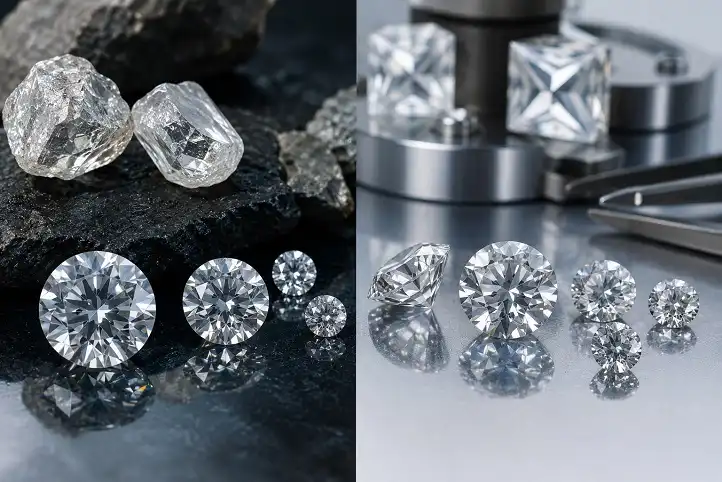
Image Credit: Bangkok Gems News
The September 8–12 event at Queen Sirikit National Convention Center will bring together around 700 participants across 1,800 booths, with diamonds and lab-grown diamonds both listed among the official product categories. Against that backdrop, this Bangkok Gems News report examines a diamond market that is becoming increasingly divided not simply by how stones are produced, but by price, consumer expectations, retailer margins and perceptions of long-term value.
Two Diamond Markets Under One Roof
The presence of natural and lab-grown diamonds at the same Bangkok exhibition is hardly unusual anymore. What makes September interesting is how dramatically the economics of the two markets have diverged.
Lab-grown diamonds have allowed consumers to purchase much larger stones for budgets that would never buy comparable natural diamonds. That price advantage has transformed parts of the jewelry market, particularly bridal jewelry.
But the relentless decline in lab-grown prices is creating another problem: what happens when today’s attractively priced diamond is available substantially cheaper tomorrow?
According to a June 2026 diamond-market report from De Beers, wholesale prices for synthetic lab-grown diamonds have declined by 93 percent since 2020. The report put average synthetic lab-grown wholesale prices at around $75 per carat, while warning that increasing competition could place further pressure on retail pricing and margins.
De Beers is a natural-diamond producer and therefore has an obvious commercial interest in differentiation between the two categories. Nevertheless, the scale of lab-grown price erosion is also reflected in independent jewelry-industry reporting.
JCK reported that lab-grown wholesale prices fell another 14 percent during the first quarter of 2026. Larger stones experienced some of the steepest declines, with three-carat rounds falling 28 percent and one-carat rounds dropping 15 percent. That creates a fascinating backdrop for Bangkok.
Bigger Is No Longer the Only Lab-Grown Story
For several years, the simplest selling point for lab-grown diamonds was size: consumers could get substantially more diamond for their money.
That equation may now be changing.
JCK reported in May that the lab-grown sector was increasingly moving toward better-quality stones, including higher colors and clarities, rather than concentrating exclusively on producing ever-larger diamonds.
That could become significant for buyers at the coming 74th Bangkok Gems and Jewelry Fair 2026.
If large lab-grown stones become commonplace and inexpensive, size itself becomes less effective as a point of differentiation. Manufacturers and retailers may instead need exceptional cuts, higher specifications, unusual designs and stronger jewelry concepts to maintain attractive selling prices.
The question for exhibitors is therefore no longer simply whether they can offer a three, four or five-carat lab-grown diamond. It is what makes that stone — and the jewelry containing it — worth choosing over hundreds of similar products.
Natural Diamonds Finally Show Signs of Stabilizing
Natural diamonds arrive at the 74th fair with challenges of their own.
The market has endured a difficult period marked by excess inventory, weak Chinese demand, competition from synthetics and pressure on polished prices.
But the latest figures provide at least some evidence that the downward cycle may be easing.
Rapaport reported on August 4 that July was the first month since March 2025 in which all four major diamond-size categories it tracks produced flat or positive results.
Its one-carat RAPI index was stable in July, ending 13 consecutive months of declines. Prices for 0.30-carat diamonds increased 1.6 percent during the month, while 0.50-carat stones rose 1.8 percent. Three-carat diamonds gained 0.2 percent.
That does not mean natural diamonds have suddenly entered another boom.
In May, prices for one-carat diamonds were still more than 15 percent below their level a year earlier, while 0.30 and 0.50-carat categories were down 27.6 percent and 29.1 percent respectively year-on-year.
But stabilization matters. September’s Bangkok fair comes just as the natural-diamond trade is looking for evidence that the worst of the prolonged price decline may finally be passing.
Bangkok Buyers Could Reveal Where Demand Is Moving
Trade shows provide something that market statistics cannot: thousands of individual purchasing decisions.
Buyers walking through QSNCC will be able to compare natural and lab-grown diamonds within the same enormous marketplace. Some will be looking for price. Others will prioritize margins, rarity, jewelry design or consumer demand in their home markets.
That makes Bangkok particularly interesting. The 74th Bangkok gem sand Jewelry Fair is not exclusively a diamond exhibition. Its official categories also include gemstones, fine jewelry, gold jewelry, silver jewelry, pearls, precious metals, synthetic stones, machinery, equipment and jewelry parts.
Diamond suppliers will therefore be competing not only with each other but also for purchasing budgets that can be directed toward colored gemstones and other jewelry categories.
Lab-Grown Diamonds Face an Unusual Problem
Falling prices sound attractive from the consumer’s perspective, but they are more complicated for the trade.
A retailer buying inventory today has to consider what equivalent inventory could cost several months later. Persistent wholesale depreciation can make stocking decisions more difficult and potentially leave companies holding goods purchased above prevailing replacement costs.
Yet declining prices have not eliminated demand. The tension is precisely what makes the sector so interesting: lab-grown diamonds can remain popular with consumers while simultaneously becoming more difficult for parts of the supply chain to price profitably.
The market is already adapting. As higher colors, better clarity and improved cutting become part of the lab-grown proposition, the next competitive battlefield could move from simply offering “more carats for less money” toward creating better jewelry around increasingly inexpensive stones.
Natural Diamonds Still Have Rarity on Their Side
Natural diamonds cannot compete with laboratory production on price, and increasingly they may not attempt to.
Their commercial proposition is fundamentally different: geological rarity, natural origin and the finite character of supply.
That distinction could become sharper as lab-grown production expands and manufacturing costs fall. Instead of the two categories becoming increasingly alike, falling lab-grown prices may ultimately push them further apart in the minds of consumers.
The Bangkok fair should provide an excellent place to watch that separation unfold.
One showcase could offer a natural diamond positioned around rarity and provenance. Another could present a substantially larger lab-grown stone emphasizing appearance, quality and affordability.
Both are diamonds in physical and chemical terms, but commercially they are increasingly behaving like two different products.
September Could Expose the Diamond Market’s New Reality
The most revealing development at the 74th Bangkok Gems and Jewelry Fair may therefore not be whether natural or lab-grown diamonds “win.” There may no longer be a single contest to win.
Natural diamonds enter September after an exceptionally difficult pricing period but with some fresh evidence of stabilization. Lab-grown diamonds arrive with strong consumer recognition and an enormous price advantage, yet face relentless wholesale depreciation and questions over how retailers can preserve margins as prices become increasingly transparent.
For buyers walking Bangkok’s 1,800 booths, those competing forces will become practical purchasing decisions rather than abstract industry arguments. They will decide how much inventory to buy, which sizes and qualities deserve shelf space, what their customers are requesting and where they believe sustainable profits can still be made.
That is why September matters. The 74th Bangkok Gems and Jewelry Fair will put natural and lab-grown diamonds inside the same international marketplace at a particularly revealing moment for both. Instead of settling the long-running natural-versus-lab-grown debate, Bangkok could demonstrate that the industry is entering a new phase in which the two categories increasingly occupy different price points, satisfy different consumer motivations and require very different retail strategies.
The real battle may no longer be over which diamond is “better.” It may be over which proposition buyers believe they can successfully sell when they return home from Bangkok.
For more details or to register for the coming 74th Bangkok Gems and Jewelry Fair, visit: