

Key points
- In the middle of this rapidly changing commercial landscape, this Bangkok Gems News report examines how the disruption is exposing the industry’s dependence on established border routes while forcing traders on both sides to search for alternatives that are generally more complicated and expensive.
- The continuing border conflict between Thailand and Cambodia is sending fresh tremors through the regional gems and jewelry industry, disrupting a trading relationship that has connected miners, gemstone dealers, cutters and exporters for generations.
- For the gem trade, it has functioned as an important commercial corridor through which Cambodian rough stones entered Thailand for treatment, cutting, polishing, certification, trading and eventual sale to international buyers.
The continuing border conflict between Thailand and Cambodia is sending fresh tremors through the regional gems and jewelry industry, disrupting a trading relationship that has connected miners, gemstone dealers, cutters and exporters for generations. The Thai-Cambodian frontier has long operated as more than a political boundary. For the gem trade, it has functioned as an important commercial corridor through which Cambodian rough stones entered Thailand for treatment, cutting, polishing, certification, trading and eventual sale to international buyers.
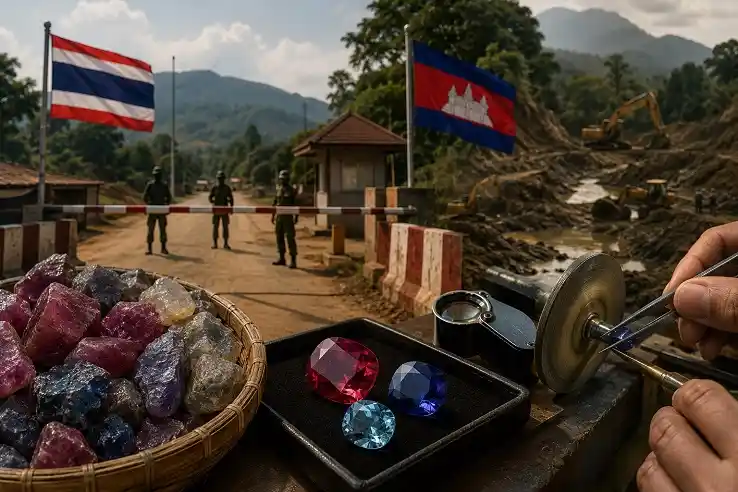
Image Credit: Bangkok Gems News
That established system is now under severe pressure as tighter border controls, checkpoint closures and restrictions on cross-border commerce interrupt the traditional movement of gemstones. Independent traders and larger wholesale networks that once transported rough stones overland are being forced to reconsider how they conduct business. In the middle of this rapidly changing commercial landscape, this Bangkok Gems News report examines how the disruption is exposing the industry’s dependence on established border routes while forcing traders on both sides to search for alternatives that are generally more complicated and expensive.
A Historic Gemstone Corridor Comes Under Pressure
For decades, the border provinces of eastern Thailand and western Cambodia formed part of a closely interconnected gemstone economy. Rough material originating in Cambodia could move relatively quickly into established Thai trading and manufacturing centers, particularly Chanthaburi, which has developed an international reputation for colored gemstone trading, heat treatment and skilled cutting.
Sa Kaeo and Trat have also played roles in cross-border commercial activity, while Bangkok remains a major destination for wholesalers, jewelry manufacturers, exporters and international buyers.
The tightening of border access has therefore created consequences extending far beyond the checkpoints themselves. When rough gemstones cannot move through their normal channels, Thai manufacturers and dealers face delays in securing material, while Cambodian miners and traders lose convenient access to the sophisticated processing infrastructure available in Thailand.
The disruption is especially significant for smaller operators. Large companies may have the financial capacity to redirect shipments through longer routes or absorb higher transportation costs, but independent miners, brokers and small workshops have considerably less room to manoeuvre.
Pailin Rubies and Sapphires Face Major Disruption
Among the stones most exposed to the crisis are rubies and sapphires associated with Cambodia’s historic Pailin mining region. Located close to the Thai frontier, Pailin has maintained longstanding commercial connections with Thailand’s Chanthaburi gemstone industry.
Traditionally, rough corundum could be transported into Thailand for assessment, heat treatment, precision cutting and subsequent marketing. Restrictions affecting the border threaten this familiar chain, potentially leaving material sitting with miners and traders for longer periods while legitimate commercial routes remain difficult.
Any prolonged disruption could also reshape purchasing behavior. Buyers who cannot depend on regular Cambodian supplies may increasingly seek comparable rough material from other producing countries, potentially weakening commercial relationships that took decades to establish.
Ratanakiri Zircon Confronts Rising Logistics Costs
Cambodia’s celebrated zircon production is another part of the trade facing logistical pressure. Ratanakiri, in northeastern Cambodia, is known internationally for zircon material prized for its brilliance, fire and distinctive appearance after treatment.
When established overland networks become unreliable, traders may have to consider air freight and alternative transit arrangements. Moving comparatively small parcels of valuable stones by air can be practical, but increased freight charges, insurance, documentation and handling requirements inevitably influence the final wholesale price.
For dealers operating on narrow margins, even modest increases in logistics costs can become commercially significant when repeated across numerous shipments.
Lower-Value Stones Could Feel the Hardest Blow
The effects are not confined to expensive rubies, sapphires and zircon. Amethyst, quartz and various ornamental materials traded around border communities may be particularly vulnerable because their economics depend heavily on inexpensive transportation and accessible local markets.
These stones often support smaller merchants, craftspeople and informal traders rather than major international gem houses. A costly logistical detour that might be manageable for a parcel of high-value sapphires could make little economic sense for lower-value rough or ornamental material.
Consequently, the deepest social impact could ultimately be felt among border communities whose incomes depend on regular, relatively small transactions with Thai buyers, craftspeople and visitors.
Thai Traders Look Beyond Traditional Supply Routes
The industry is already being pushed toward alternative supply-chain strategies. Where commercially viable, larger traders can explore maritime shipping, air cargo and third-country transit rather than depending exclusively on direct land crossings.
At the same time, Thailand’s gemstone sector has strong incentives to accelerate diversification of its sources of rough material. African producing countries, particularly Madagascar and Mozambique, have become increasingly important to the international-colored gemstone business and offer Thai manufacturers alternative sources of rubies, sapphires and other valuable stones.
Diversification can strengthen supply security, but it does not immediately replace the advantages of proximity. Cambodia’s geographic closeness to Thailand historically allowed traders to inspect, purchase, transport and process stones within a tightly connected regional marketplace.
Chanthaburi’s Expertise Remains a Powerful Advantage
Thailand retains an important strength despite the disruption: its accumulated expertise. Chanthaburi’s gemstone ecosystem includes experienced dealers, cutters, treaters and specialists whose skills cannot simply be recreated by changing a transportation route.
That expertise means Cambodian material is still commercially compatible with the Thai gemstone sector. The difficulty is getting stones from mine and dealer to processing center efficiently, legally and at a cost that makes economic sense.
This distinction is important. The current disruption does not necessarily represent a disappearance of demand for Cambodian gemstones or a loss of Thailand’s manufacturing capabilities. Rather, it is a breakdown in the physical and commercial connections that historically brought those two strengths together.
A Regional Gem Trade at a Turning Point
The longer restrictions remain in place, the greater the possibility that temporary solutions will develop into permanent trading patterns. Thai buyers who establish dependable relationships with alternative suppliers may continue those relationships even after border conditions improve. Cambodian traders who successfully develop direct export channels or new processing partnerships could likewise become less dependent on Thailand than they were previously.
Yet geography, commercial history and specialist expertise continue to bind the two gemstone industries together. Cambodia possesses important gemstone resources, while Thailand offers sophisticated treatment, cutting, manufacturing and international marketing capabilities. Restoring predictable legal trade would therefore benefit businesses and communities on both sides of the frontier.
For now, the border crisis represents much more than a transportation problem for the gems and jewelry sector. It is testing a regional business model built over generations and demonstrating how quickly geopolitical tension can alter the journey of a gemstone from mine to international marketplace. Whether the historic Cambodian-Thai gemstone corridor eventually returns to its former rhythm or emerges permanently transformed will depend on border stability, commercial adaptation and the ability of businesses to build resilient supply chains without abandoning longstanding regional relationships.