

Key points
- A collector unable or unwilling to pay the premium demanded for an exceptional ruby may consider a fine spinel, garnet or tourmaline offering striking color and individuality.
- The 74th Bangkok Gems and Jewelry Fair 2026, scheduled for September 8–12 at the Queen Sirikit National Convention Center, comes at an intriguing moment for the international gemstone business.
- A March 2026 market assessment by Thailand’s Department of International Trade Promotion (DITP), drawing on trading conditions at the Tucson gem shows, identified garnet, spinel and tourmaline among colored stones attracting strong interest.
When the doors open for the 74th Bangkok Gems & Jewelry Fair in September, the real story may not be how many exhibitors fill the halls, but what international buyers are searching for once they get inside. Colored stones — particularly those with distinctive hues, limited availability and a compelling story — are emerging as one of the most closely watched areas of the market.
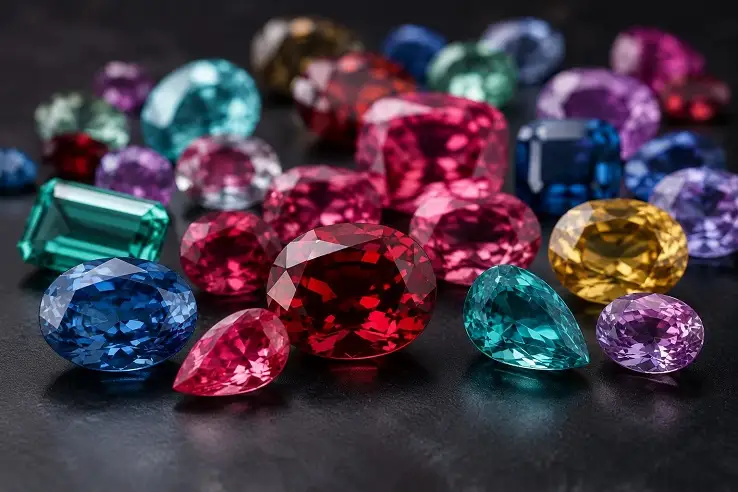
Image Credit: Bangkok Gems News
The 74th Bangkok Gems and Jewelry Fair 2026, scheduled for September 8–12 at the Queen Sirikit National Convention Center, comes at an intriguing moment for the international gemstone business. Buyers remain selective, but evidence from overseas markets suggests they have hardly lost their appetite for exceptional stones. In fact, this Bangkok Gems News report finds that the buying conversation increasingly appears to be shifting toward rarity, individuality and stones that stand apart from conventional commercial goods.
Red and Pink Could Command Attention
Ruby will inevitably remain important in Bangkok. Thailand’s long association with ruby trading, cutting, treatment and jewelry manufacturing ensures that serious buyers will continue searching for attractive material across different price levels.
But ruby may have company.
A March 2026 market assessment by Thailand’s Department of International Trade Promotion (DITP), drawing on trading conditions at the Tucson gem shows, identified garnet, spinel and tourmaline among colored stones attracting strong interest. Particularly notable was Mahenge spinel with intense reddish-pink coloration, with prices for desirable material rising strongly enough to compete with high-quality sapphire in some segments.
Rubellite tourmaline and red garnet were also attracting buyers, suggesting that the broader red-to-pink palette — rather than ruby alone — could be an important theme when international buyers reach Bangkok.
For dealers, that potentially creates opportunities at several price points. A collector unable or unwilling to pay the premium demanded for an exceptional ruby may consider a fine spinel, garnet or tourmaline offering striking color and individuality.
Spinel’s Rise Is Becoming Hard to Ignore
Spinel has spent years escaping its historical position in the shadow of ruby and sapphire. In 2026, it increasingly looks capable of standing on its own.
Fine red and pink spinels are particularly interesting because scarcity remains a significant factor. Strong color, attractive cutting and larger sizes can quickly separate exceptional stones from ordinary commercial material.
The broader appeal also fits a changing market. Buyers searching for something less predictable than the traditional “big three” of ruby, sapphire and emerald have increasingly compelling alternatives.
That means Bangkok sellers holding distinctive spinels could find themselves well positioned in September — particularly where quality, origin and documentation can support the stone’s value.
Paraíba Tourmaline Remains on the Radar
Few modern-colored stones have generated the excitement surrounding Paraíba tourmaline.
DITP’s 2026 analysis pointed to continuing demand for the electric blue-green stone, particularly material associated with Mozambique, while noting the limited availability of high-quality Brazilian stones.
A separate DITP assessment of the US jewelry market identified Paraíba tourmaline among several colored gemstones attracting particular attention in 2026, alongside alexandrite, parti sapphire, teal sapphire, spinel and mandarin garnet.
That list is revealing. Buyers are not necessarily chasing one dominant gemstone trend. They appear increasingly interested in unusual colors and visual characteristics that give designers something different to work with.
Sapphire Is Evolving Beyond Classic Blue
Bangkok buyers will certainly still be looking at fine blue sapphire, but the sapphire market has become considerably broader.
Teal sapphires and parti sapphires — stones displaying combinations of blue, green and yellow — are examples of material benefiting from greater consumer willingness to embrace individuality.
This creates a different buying proposition from the traditional pursuit of perfectly saturated blue.
A stone that might once have been considered unconventional can now become desirable precisely because no two examples look identical. For independent designers and jewelers seeking pieces that photograph strongly and cannot easily be duplicated, that distinction matters.
Thailand’s Gem and Jewelry Institute has also pointed to strong demand for ruby, sapphire and emerald, particularly high-quality stones with credible origins.
Buyers Want More Than a Beautiful Stone
One of the most important developments may have little to do with color.
Documentation, origin information and traceability are increasingly part of the purchasing equation, particularly for valuable gemstones.
DITP’s assessment of the US market noted that buyers are considering not only appearance but also origin, certification and traceability, with properly documented gemstones capable of inspiring greater confidence.
For Bangkok dealers, that could make laboratory reports and reliable disclosure more commercially important. A beautiful stone still has to attract the eye, but the questions that follow — where is it from, has it been treated, what documentation accompanies it? — can become crucial when significant money is involved.
The Middle Market Faces a Tougher Test
Not every gemstone category is likely to enjoy the same momentum.
One striking feature of the 2026 market is the apparent polarization between affluent consumers continuing to purchase expensive luxury goods and more price-sensitive consumers becoming cautious.
DITP reported that this divide was visible at Tucson, where some high-end gemstone dealers were able to sell individual stones valued at hundreds of thousands of dollars while trading in the middle segment was slower.
That could influence Bangkok purchasing. Buyers may be prepared to spend heavily on genuinely exceptional stones, while negotiating much harder over material that is attractive but relatively replaceable. In other words, being merely “good” could become a difficult place for a gemstone to sit.
Bangkok Becomes the Testing Ground
The scale of September’s fair should provide an unusually useful snapshot of these trends.
The 74th Bangkok Gems & Jewelry Fair is scheduled to host around 700 participants and 1,800 booths, with product categories extending from gemstones and fine jewelry to diamonds, synthetic stones, lab-grown diamonds, pearls, precious metals, machinery and equipment.
But for the colored-stone trade, the most revealing evidence will be found in actual purchasing decisions.
Do buyers head first for ruby and blue sapphire? Does the momentum behind spinel translate into orders? Are teal and parti sapphires moving from fashionable niches into mainstream inventories? Can Paraíba tourmaline maintain its extraordinary attraction despite increasingly elevated prices? And which obscure stone suddenly becomes September’s surprise success?
Those questions are more revealing than predictions because gem fairs ultimately operate as marketplaces, not fashion surveys.
Rarity May Be September’s Most Valuable Commodity
There is good reason to believe that buyers arriving in Bangkok will still want the stones for which the city has long been famous. Ruby and sapphire are hardly about to surrender their positions at the center of Thailand’s colored-stone business.
What is changing is the territory surrounding them. Spinel, tourmaline, unusual sapphires, alexandrite, garnet and other distinctive stones are giving buyers a much wider palette. At the same time, provenance, treatment disclosure, certification and genuine rarity are becoming increasingly important differentiators.
The strongest signal from the market is therefore unlikely to be that one gemstone has suddenly replaced another. Instead, September could demonstrate something more significant: international buyers are becoming increasingly willing to search beyond traditional categories when color, rarity, quality and story come together.
For Bangkok dealers, that means the winning stone may not necessarily be the most famous one in the showcase. It could be the stone buyers have rarely seen before, cannot readily source elsewhere and know they may regret leaving behind.
When thousands of gemstones are placed under the lights at Queen Sirikit National Convention Center, watching which trays buyers return to for a second look could tell the industry more about the direction of the colored-stone market than any forecast. Bangkok has long been a place where global gemstone supply meets international demand, and September’s fair could provide an important test of just how far buyer tastes are shifting toward individuality and scarcity.
For registration or more details: visit: