

Key points
- What is emerging is a more complex, interconnected trade network – one that is less dependent on a single source and more reflective of a rapidly changing global landscape.
- While uncertainty remains, Bangkok’s ability to pivot quickly suggests that its role in the global gem trade is far from diminished and may, in fact, become even more strategically important in the years ahead.
- Bangkok’s long-standing position as a global hub for colored gemstones is undergoing a quiet but significant transformation as supply disruptions from Myanmar begin to bite deeper into the trade.
Bangkok Gems News: Supply Shock Ripples Across Bangkok’s Gem Markets
Bangkok’s long-standing position as a global hub for colored gemstones is undergoing a quiet but significant transformation as supply disruptions from Myanmar begin to bite deeper into the trade. For decades, Myanmar has been the primary source of some of the world’s finest rubies and jade, feeding Thailand’s cutting, trading, and export ecosystem. However, ongoing political instability, tightened border controls, and unpredictable mining outputs have severely disrupted this once-reliable pipeline.
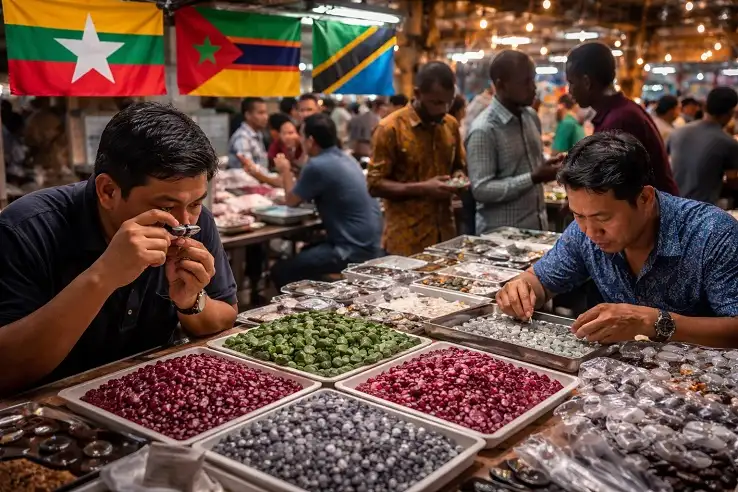
Image Credit: Bangkok Gems News
Traders in key districts such as Silom and along the Chanthaburi trading routes are now facing inconsistent shipments, rising prices, and declining quality in incoming stones. This Bangkok Gems News report finds that many dealers are no longer waiting for stability to return. Instead, they are rapidly reconfiguring their sourcing strategies in ways that could permanently reshape the industry’s foundations.
Traders Pivot to Africa and Beyond
In response to the Myanmar shortage, Bangkok-based traders are increasingly turning their attention toward alternative sources, particularly in Africa. Countries such as Mozambique, Madagascar, and Tanzania are seeing a surge in Thai buyer activity, with traders establishing new supply chains almost in real time.
One veteran ruby dealer, who has operated in Bangkok for over two decades, described the shift as both necessary and risky. African stones, while abundant, often require different cutting techniques and come with varying levels of clarity and color consistency. This forces Thai artisans to adapt quickly, blending traditional expertise with new approaches to maintain global competitiveness.
Meanwhile, younger traders are proving more agile. Leveraging digital communication tools and on-the-ground partnerships, they are bypassing traditional intermediaries and sourcing directly from mining regions. This not only reduces costs but also allows them to secure more consistent inventory, albeit with higher logistical complexity.
Changing Economics and Buyer Preferences
The supply shift is also influencing pricing structures and buyer behavior. With premium Myanmar rubies becoming rarer and more expensive, international buyers are showing increased openness to African stones that offer similar visual appeal at more accessible price points. Bangkok’s dealers are capitalizing on this trend by rebranding and repositioning these gems in global markets.
However, not all segments are adapting equally. High-end collectors still prioritize Myanmar-origin stones for their prestige and historical value, creating a widening gap between luxury and mid-tier markets. This divergence is prompting some Bangkok traders to specialize further, focusing either on ultra-premium rare stones or on volume-driven alternative gems.
A Market in Transition
The transformation is not without challenges. Supply chain uncertainties, fluctuating quality, and geopolitical risks continue to loom large. Yet, many in the industry see this as a pivotal moment rather than a crisis. By diversifying sourcing strategies and embracing new markets, Bangkok is reinforcing its resilience as a global gemstone hub.
What is emerging is a more complex, interconnected trade network – one that is less dependent on a single source and more reflective of a rapidly changing global landscape. Traders who can navigate this complexity are likely to define the next chapter of Bangkok’s gem industry.
In the broader picture, the Myanmar disruption may ultimately serve as a catalyst for long-term evolution. It is forcing the industry to innovate, adapt, and rethink traditional dependencies. While uncertainty remains, Bangkok’s ability to pivot quickly suggests that its role in the global gem trade is far from diminished and may, in fact, become even more strategically important in the years ahead.
For the latest on the gem markets in Thailand, keep on logging to Bangkok Gems News.