

Key points
- Thailand’s gems and jewelry sector is facing rising internal tension as a growing number of local Thai jewelers, gemstone suppliers, wholesalers, and retail store owners call on authorities to impose tighter restrictions on foreign participation, particularly from Indian traders.
- For Thailand, maintaining its standing as a trusted gemstone and jewelry hub will depend on how effectively it addresses these concerns without undermining the collaborative foundations that helped build the industry in the first place.
- Industry insiders claim that certain practices by a segment of foreign operators are eroding trust and undermining Thailand’s reputation as a global hub for quality gemstones and fine jewelry.
Bangkok Gems News: Industry Voices Grow Louder Over Alleged Irregularities
Thailand’s gems and jewelry sector is facing rising internal tension as a growing number of local Thai jewelers, gemstone suppliers, wholesalers, and retail store owners call on authorities to impose tighter restrictions on foreign participation, particularly from Indian traders. While the relationship between Thai and Indian players has historically been collaborative and beneficial, recent concerns have shifted the tone toward caution and protectionism. Industry insiders claim that certain practices by a segment of foreign operators are eroding trust and undermining Thailand’s reputation as a global hub for quality gemstones and fine jewelry.
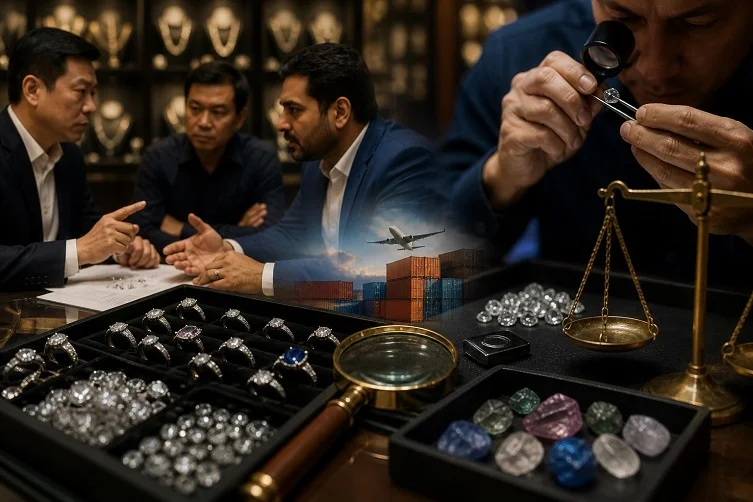
Image Credit: Bangkok Gems News
Concerns Over Certification Fraud and Market Integrity
Among the most serious allegations are claims of fraudulent gemstone certifications and misleading practices involving diamonds. Reports suggest that some Indian operators have been issuing fake grading certificates or using counterfeit laser engravings to falsely authenticate stones. This Bangkok Gems News report highlights how such practices not only deceive buyers but also damage the credibility of legitimate Thai businesses that rely on trust and transparency to compete internationally. In addition, there are accusations of undisclosed mixing of lab-grown diamonds with natural stones, particularly in smaller parcels or as filler stones in finished jewelry pieces, making detection difficult for unsuspecting buyers.
Allegations of Financial Misconduct and Trade Loopholes
Beyond product integrity issues, some stakeholders have raised alarms about alleged financial misconduct, including money laundering activities linked to certain trading operations. Industry figures also point to Thailand being used as a transit base for goods originating from India to enter markets such as the United States while bypassing tariffs or trade restrictions. Such activities, if proven, could expose Thailand to regulatory scrutiny and jeopardize trade relationships with key international partners. Local business owners argue that these loopholes unfairly advantage a few while placing the broader industry at risk.
Economic Friction and Calls for Policy Intervention
The debate is not without complexity. Many Indian entrepreneurs have played a crucial role in building Thailand’s jewelry trade over decades, contributing expertise, global networks, and investment. However, critics argue that an imbalance has emerged, with some foreign traders allegedly prioritizing rapid profits over ethical standards, thereby enriching themselves at the expense of local stakeholders. This has led to calls for stricter licensing requirements, enhanced monitoring of gemstone certification processes, and more rigorous enforcement of existing trade and financial regulations.
Balancing Growth with Reputation Protection
Industry observers caution that any policy response must strike a careful balance. Overly restrictive measures could disrupt supply chains and harm Thailand’s competitiveness, while inaction risks long-term reputational damage. The consensus among many Thai jewelers is not to exclude foreign participation entirely, but to ensure that all players operate under transparent and enforceable standards that protect the integrity of the market.
The situation reflects a broader challenge facing global luxury goods industries, where authenticity, traceability, and ethical practices are becoming increasingly critical. For Thailand, maintaining its standing as a trusted gemstone and jewelry hub will depend on how effectively it addresses these concerns without undermining the collaborative foundations that helped build the industry in the first place. The path forward will likely require stronger oversight, industry cooperation, and a renewed commitment to fair trade practices that benefit both local and international stakeholders.
For the latest on the local Gems and Jewelry industry, keep on logging to Bangkok Gems News.