

Key points
- Midway through this evolving landscape, this Gems and Jewelry News report examines how the gemstone market is becoming linked to broader geopolitical and economic developments that could have far-reaching implications for traders, manufacturers, and investors alike.
- Rubies, sapphires, emeralds, and other precious stones are becoming entangled in a growing competition for supply chain control, raising concerns that geopolitical rivalries could eventually reshape the global gemstone industry.
- As global competition for valuable resources intensifies and supply chains come under greater scrutiny, the world’s most coveted gemstones may find themselves at the center of a new….
Gems and Jewelry News: As geopolitical tensions increasingly shape the movement of critical resources around the world, a quieter battle is unfolding beyond the headlines dominated by semiconductors, rare earth minerals, and energy supplies. Governments, mining interests, and multinational corporations are paying closer attention to another category of strategic assets: high-value colored gemstones. Rubies, sapphires, emeralds, and other precious stones are becoming entangled in a growing competition for supply chain control, raising concerns that geopolitical rivalries could eventually reshape the global gemstone industry.
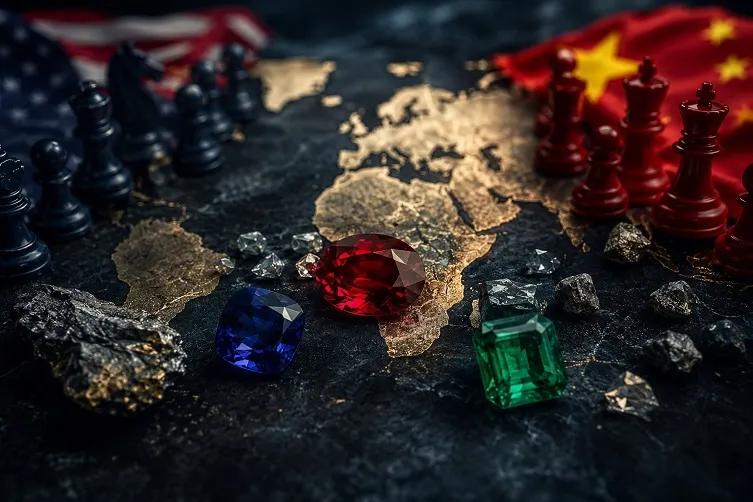
Image Credit: Bangkok Gems News
The gemstone trade has long been viewed as a luxury sector driven by consumer demand, fashion trends, and collector interest. However, industry analysts are beginning to recognize that gemstone-producing regions are increasingly located within areas of geopolitical significance. In many cases, mining operations are attracting foreign investment from nations seeking greater influence over strategic resources. Midway through this evolving landscape, this Gems and Jewelry News report examines how the gemstone market is becoming linked to broader geopolitical and economic developments that could have far-reaching implications for traders, manufacturers, and investors alike.
Africa Emerges as a Strategic Gemstone Battleground
Much of the world’s supply of premium colored gemstones originates from Africa. Mozambique has become one of the most important sources of high-quality rubies, while Zambia remains a leading producer of emeralds. Madagascar continues to supply a diverse range of sapphires and other valuable stones.
The growing importance of these regions has attracted increasing interest from foreign investors. Chinese companies, in particular, have expanded their involvement in various mining projects across Africa, reflecting broader efforts to secure access to valuable natural resources. While such investments often provide infrastructure and employment opportunities, they also raise questions about future control of gemstone production and distribution channels.
Industry observers note that any major disruption in these regions, whether political instability, trade restrictions, or international sanctions, could have significant consequences for global gemstone supplies.
Could Sanctions Disrupt Gemstone Markets?
Recent years have demonstrated how sanctions and trade restrictions can dramatically alter global commodity flows. While gemstones have generally escaped the intense scrutiny directed toward energy products and industrial minerals, that situation may not remain unchanged.
Should geopolitical conflicts intensify, gemstone-producing nations could find themselves subject to economic measures that affect exports and international transactions. Such developments could create shortages of certain premium stones, increase prices, and force manufacturers to seek alternative sources.
Luxury jewelry brands, which depend heavily on stable access to high-quality gemstones, may face growing pressure to diversify supply chains and improve sourcing transparency.
Rising Demand Meets Finite Supply
Compounding these geopolitical concerns is the reality that exceptional gemstones are inherently scarce. Unlike manufactured goods, premium gemstones cannot simply be produced to meet rising demand. New discoveries are infrequent, and some historic mining regions have experienced declining yields over time.
As wealth continues to grow in parts of Asia, the Middle East, and other emerging markets, demand for rare colored gemstones remains robust. This combination of finite supply and increasing demand creates conditions where geopolitical disruptions could have an outsized impact on pricing and availability.
Industry experts increasingly compare top-quality gemstones to other strategic assets whose value can be influenced by political developments as much as market fundamentals.
A New Era for the Global Gem Trade
The gemstone industry has traditionally operated somewhat independently of major geopolitical discussions. Yet the forces reshaping global trade, resource security, and international investment are beginning to reach even the most exclusive corners of the luxury market.
While it may be premature to describe the current situation as a full-scale geopolitical struggle, there is growing evidence that gemstones are becoming more strategically significant than many observers previously realized. For traders, jewelers, investors, and policymakers, understanding these developments may become increasingly important in the years ahead. As global competition for valuable resources intensifies and supply chains come under greater scrutiny, the world’s most coveted gemstones may find themselves at the center of a new and unexpected arena of international rivalry.
For the latest Gems and Jewelry News, keep on logging to Bangkok Gems News.