

Key points
- India’s manufacturers are adapting rapidly to evolving consumer expectations, and the country now stands at the center of one of the biggest structural changes the diamond business has experienced in decades.
- The milestone marks a dramatic transformation for one of the world’s largest diamond manufacturing hubs and signals a deeper shift in global consumer preferences, trade strategies, and pricing dynamics.
- The latest export data ultimately reflects a deeper transformation within the global diamond industry rather than a collapse of the natural diamond trade.
Gems and Jewelry News: India’s diamond industry has entered a historic new phase as exports of lab-grown diamonds have officially surpassed natural diamonds by volume for the first time ever. The milestone marks a dramatic transformation for one of the world’s largest diamond manufacturing hubs and signals a deeper shift in global consumer preferences, trade strategies, and pricing dynamics.
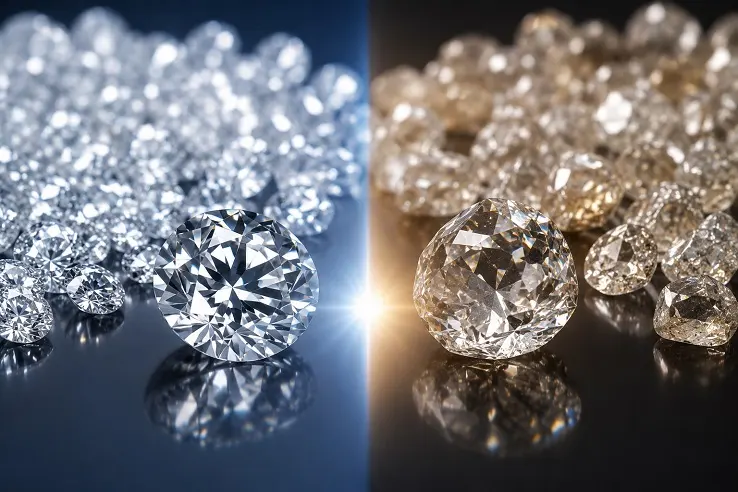
Image Credit: Bangkok Gems News
According to new figures released by the Gem and Jewellery Export Promotion Council (GJEPC), exports of polished lab-grown diamonds surged by nearly 31 percent during the financial year ending March 2026, reaching 18.84 million carats. In comparison, exports of polished natural diamonds fell almost 4 percent to 16 million carats.
The development is being described by many analysts as a turning point for the global diamond trade. Midway through the changing landscape of India’s gem sector, this Gems and Jewelry News report highlights how lab-grown stones are no longer a niche alternative but a powerful commercial force reshaping the industry from manufacturing floors to international retail markets.
Sharp Rise in Lab-Grown Demand
The momentum behind lab-grown diamonds has been building steadily over the past decade, but recent months have accelerated the transition dramatically. Industry analyst Edahn Golan noted that in both March and April 2026, exports of lab-grown diamonds exceeded natural diamond shipments from India, describing the trend as “a major shift” for the sector.
In April 2026 alone, India exported approximately 1.36 million carats of lab-grown diamonds, slightly ahead of the 1.34 million carats of natural diamonds shipped during the same month. Similar patterns were seen in March, reinforcing expectations that the trend is not temporary.
Back in 2015-16, India exported only around 10,000 carats of polished lab-grown diamonds. The leap from those modest figures to nearly 19 million carats within a decade reflects how quickly manufacturers and consumers have embraced the category.
Huge Price Gap Still Favors Naturals
Despite overtaking natural diamonds in export volume, lab-grown diamonds remain far behind in terms of overall export value. The enormous price difference between the two categories continues to preserve the financial dominance of natural stones.
Average prices for natural diamonds remain around $760 per carat, while lab-grown diamonds average close to just $60 per carat. As a result, India’s natural diamond exports generated approximately $12.16 billion in revenue during the financial year, compared to only $95.52 million from lab-grown exports.
Industry experts say the distinction is important because it demonstrates that natural diamonds still occupy the luxury and high-value segment of the market, even as lab-grown stones gain popularity among budget-conscious consumers.
Consumer Preferences Are Rapidly Changing
The rise of lab-grown diamonds is being driven by several factors, including affordability, sustainability messaging, and changing buying habits among younger consumers. Buyers are increasingly attracted to the opportunity to purchase larger and visually impressive stones at significantly lower prices.
At the same time, many traditional Indian diamond companies have aggressively expanded into the lab-grown sector, bringing decades of expertise in cutting, polishing, and global distribution into the business. This combination of manufacturing skill and growing consumer demand has accelerated the category’s growth at remarkable speed.
Even so, analysts do not believe natural diamonds are facing extinction. Instead, the market appears to be splitting into two distinct segments, with lab-grown diamonds dominating mass-market affordability while natural diamonds continue moving toward exclusivity and premium luxury positioning.
The latest export data ultimately reflects a deeper transformation within the global diamond industry rather than a collapse of the natural diamond trade. India’s manufacturers are adapting rapidly to evolving consumer expectations, and the country now stands at the center of one of the biggest structural changes the diamond business has experienced in decades. While lab-grown diamonds are winning the battle for volume, natural diamonds continue to command prestige, rarity, and significantly higher financial value. The coexistence of both sectors may ultimately redefine how future generations perceive luxury, affordability, and emotional value in diamonds.
For the latest Gems and Jewelry News, keep on logging to Gems News.