

Key points
- The global ruby market is entering a new phase as GemGuide has announced major updates to its pricing charts, reflecting soaring values for Mozambique rubies and a dramatic shift in the way unenhanced Burmese rubies are evaluated.
- The changes, which are already live in the GemGuide app and will officially appear in the July/August 2026 edition, highlight a market increasingly defined not by price alone, but by the challenge of securing supply.
- While Burma remains the legendary origin that establishes the benchmark for ruby quality and prestige, Mozambique has become the practical source supplying the majority of the trade.
Gems and Jewelry News: The global ruby market is entering a new phase as GemGuide has announced major updates to its pricing charts, reflecting soaring values for Mozambique rubies and a dramatic shift in the way unenhanced Burmese rubies are evaluated. The changes, which are already live in the GemGuide app and will officially appear in the July/August 2026 edition, highlight a market increasingly defined not by price alone, but by the challenge of securing supply.
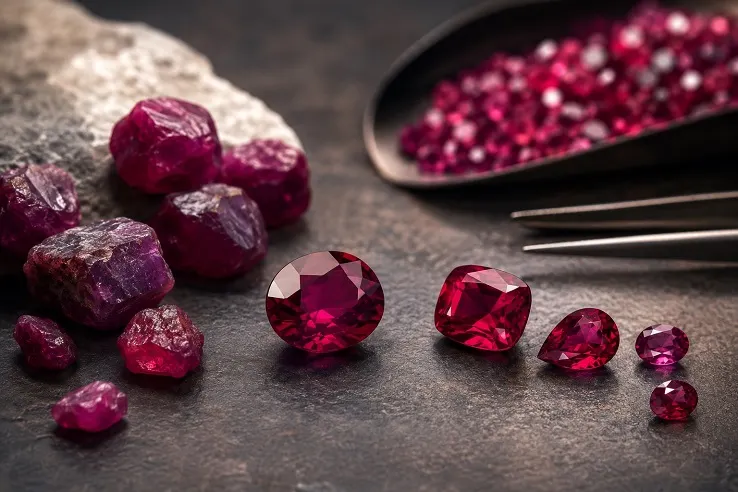
Image Credit: Bangkok Gems News
For gemstone dealers, appraisers, manufacturers, and collectors, the update represents more than a routine pricing adjustment. It signals a deeper transformation within the ruby trade, where scarcity has become one of the most powerful forces shaping market behavior. In fact, this Gems and Jewelry News report finds that the traditional relationship between quality grading and market pricing is being challenged by an unprecedented shortage of top-tier Burmese material.
Mozambique Ruby Prices Continue Their Sharp Climb
According to Gemworld International Research Director Stuart Robertson, Mozambique has been the dominant source of gem-quality and near-gem-quality ruby entering the international market for more than a decade.
While Burma remains the legendary origin that establishes the benchmark for ruby quality and prestige, Mozambique has become the practical source supplying the majority of the trade. As demand for high-quality ruby continues to strengthen, particularly for unenhanced stones, prices for Mozambique ruby have surged dramatically.
The strong market appetite has been fueled by tender sales, intense competition among buyers, and increasing interest from luxury jewelry brands seeking consistent access to premium inventory. Industry observers note that some of the finest Mozambique stones are often purchased before reaching the broader marketplace, tightening supply even further.
Despite the rapid rise in prices, demand has remained remarkably resilient. Buyers may express concern over escalating costs, but purchasing activity continues, reflecting the enduring appeal of ruby as one of the world’s most coveted colored gemstones.
Burmese Ruby Faces a Different Reality
While Mozambique ruby is experiencing significant price growth, the situation surrounding Burmese ruby has become far more complex.
GemGuide revealed that the scarcity of unenhanced Burmese ruby has reached a level where maintaining traditional pricing methods is no longer practical. For years, researchers monitored the declining availability of fine Burmese material, but the shortage has now become severe enough to require a fundamental revision of the pricing structure.
Historically, GemGuide priced Burmese ruby using a detailed quality scale spanning grades one through ten. Beginning with the July/August 2026 issue, however, the Corundum-Ruby (Attributed to Burma, Unenhanced) chart will feature only four categories: Grade 3 (Middle Commercial), Grade 5 (Lower Good), Grade 8 (Upper Fine), and Grade 10 (Upper Extra Fine).
Users seeking values for intermediate grades will be encouraged to interpolate between the listed categories.
When Availability Matters More Than Price
The decision reflects a growing reality within the gemstone trade. Researchers say they can no longer locate enough examples of fine Burmese ruby to confidently establish pricing across all quality levels.
As a result, availability has become the dominant concern. Dealers increasingly find themselves searching for suitable stones rather than negotiating prices. Material that does appear on the market frequently comes from recycled inventory, estate jewelry, or long-held dealer stock released after years in private vaults.
This trend has also altered how quality is viewed. Whereas cutting precision, polish, and finish once played a larger role in valuation discussions, traders are now placing greater emphasis on obtaining stones that closely match the ideal color and character associated with their origin.
Market Activity Concentrates at the Extremes
Industry analysts believe that market activity is increasingly focused on two distinct segments—the high end and the low end. Premium gemstones continue to attract strong demand from affluent buyers and luxury brands, while lower-priced goods maintain steady movement through commercial channels.
The mid-range categories that traditionally formed the backbone of many jewelry markets are experiencing greater pressure as consumer spending patterns evolve and sourcing challenges persist.
The latest GemGuide revisions provide one of the clearest indicators yet that the ruby industry is adapting to a new reality. Fine Burmese ruby has become so scarce that even the world’s leading pricing researchers are finding it difficult to gather enough market data to support traditional valuation models. At the same time, Mozambique continues to strengthen its position as the primary supplier meeting global demand. The result is a market where rarity, availability, and competition for quality goods are increasingly influencing pricing dynamics. For professionals throughout the gemstone sector, the message is unmistakable: the challenge is no longer determining what exceptional rubies are worth—it is finding them in the first place.
For the latest Gems and Jewelry News, keep on logging to Bangkok Gems News.