

Key points
- The move is expected to have significant implications for jewelers, manufacturers, and retailers operating within the country, while also adding momentum to the global debate over how synthetic diamonds should be represented in the marketplace.
- Russia is taking a firm stance on the rapidly growing lab-grown diamond sector, unveiling sweeping new regulations that will require synthetic stones to be clearly identified and marketed differently from their natural counterparts.
- 657 and set to take effect on September 1, 2026, are being presented as a major step toward improving transparency and strengthening consumer confidence in the jewelry market.
Gems and Jewelry News: Russia is taking a firm stance on the rapidly growing lab-grown diamond sector, unveiling sweeping new regulations that will require synthetic stones to be clearly identified and marketed differently from their natural counterparts. The measures, approved under Resolution No. 657 and set to take effect on September 1, 2026, are being presented as a major step toward improving transparency and strengthening consumer confidence in the jewelry market.
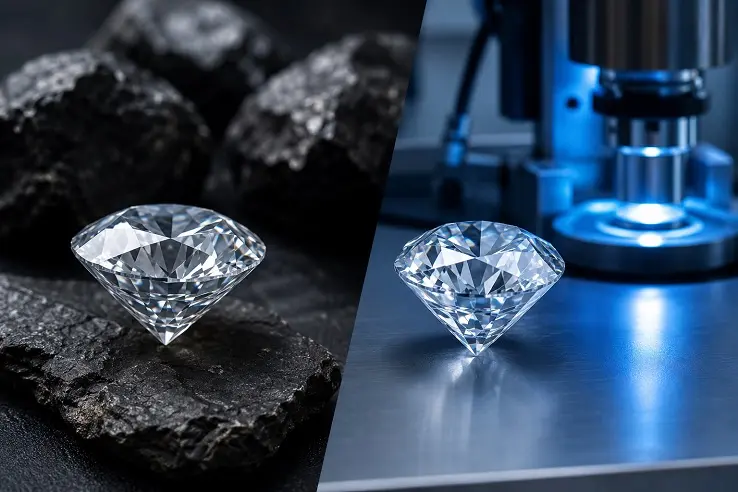
Image Credit: Bangkok Gems News
The new rules mandate that any lab-grown diamond used in jewelry must be labeled as “synthetic” or the abbreviated form “Synthet.” on all tags, labels, and consumer-facing information. In addition, synthetic diamonds will no longer be permitted to be sold using carat measurements and must instead be described by weight in grams. Industry observers say the move places Russia among the strictest regulators of lab-grown diamond terminology worldwide. This Gems and Jewelry News report highlights one of the most comprehensive efforts yet to separate natural diamonds from their laboratory-created counterparts in the eyes of consumers.
Strict Limits on Marketing Language
Under the new framework, the term “diamond” will effectively be reserved for naturally occurring stones. Retailers will be prohibited from using language that could create confusion or imply that a synthetic stone shares the same origin as a mined diamond.
Words and descriptions such as “precious,” “real,” “genuine,” “natural,” “mined,” “mineral,” and even “eco-friendly” will no longer be allowed when referring to synthetic stones. Authorities have also banned the use of quality and color descriptors commonly associated with natural diamonds in marketing materials for lab-grown products.
Russian Deputy Finance Minister Alexey Moiseev said the primary objective of the regulations is to ensure greater honesty in the marketplace and provide consumers with clear and accurate information before making purchasing decisions.
Russia Goes Further Than Many Markets
While a growing number of countries have introduced disclosure requirements for lab-grown diamonds, Russia’s regulations are notably more restrictive. Unlike the United States, the United Kingdom, the European Union, and India, which generally allow terms such as “lab-grown” or “lab-created,” Russia will only permit the use of “synthetic” or “synth.”
France is one of the few countries with comparable restrictions, having previously required man-made diamonds to be identified exclusively as synthetic rather than laboratory-grown.
The Russian measures also follow recent international developments. Earlier this year, India’s Bureau of Indian Standards introduced updated terminology guidelines for lab-grown diamonds, while the African Diamond Producers Association recently approved tighter controls on synthetic diamond descriptions.
Global Transparency Drive Gains Momentum
The latest regulations underscore a broader international push to establish clearer distinctions between natural and laboratory-created gemstones. As lab-grown diamonds continue to gain popularity and market share, governments and industry bodies are increasingly focused on ensuring that consumers fully understand the nature of the products they purchase.
By introducing mandatory synthetic labeling, restricting marketing terminology, and eliminating the use of carat measurements for lab-grown stones, Russia is sending a strong signal that transparency will take precedence over promotional language. The move is expected to have significant implications for jewelers, manufacturers, and retailers operating within the country, while also adding momentum to the global debate over how synthetic diamonds should be represented in the marketplace. As more nations evaluate similar measures, Russia’s approach could become an influential benchmark in shaping future international standards for diamond disclosure and consumer protection.
For the latest Gems and Jewelry News, keep on logging to Gems News.